

About us
Making the gaze an objective measure of brain function.
Our mission
What our eyes say about us
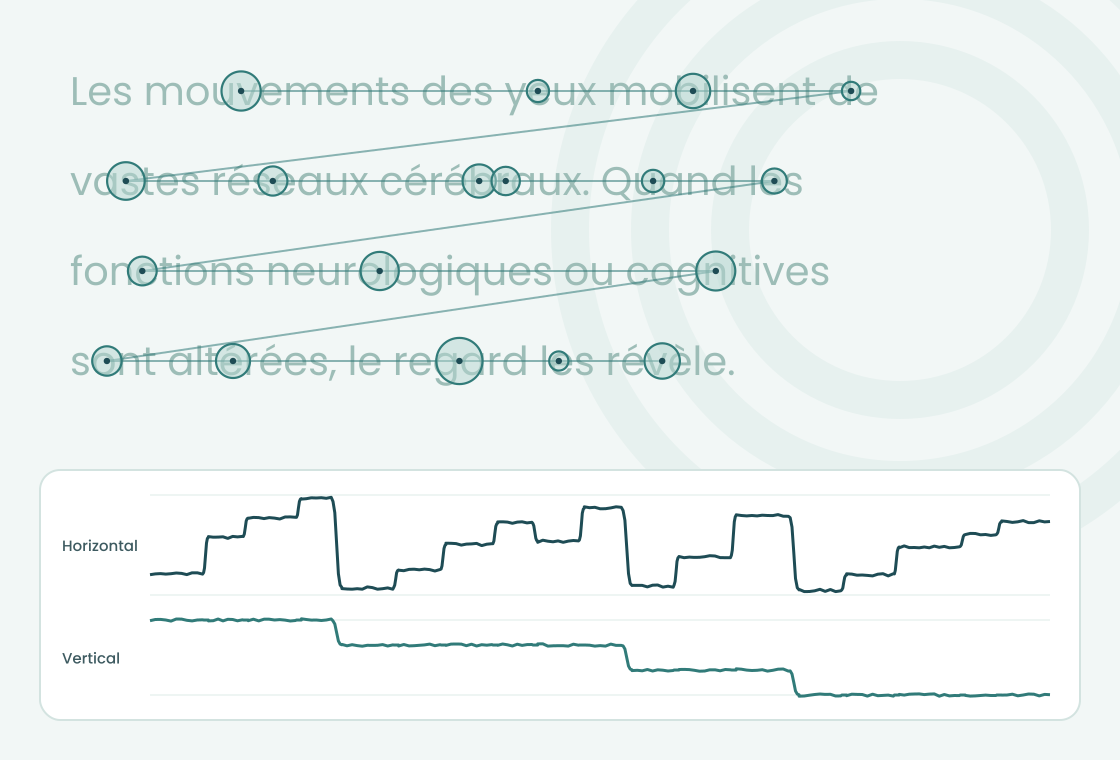
Eye movements engage vast brain networks. When neurological or cognitive functions are impaired, the gaze reveals it.
SuriCog develops digital biomarkers that measure these impairments, to support clinicians in the care of their patients and contribute to research progress.
Our ambition: to make the gaze a window on our brain health.
Science and Research
A science-based approach
The study of eye movements is an established field of research in neuroscience. Fixating a point, following a target, shifting the gaze or reacting to light: each of these actions engages different brain regions, from motor control to attention and memory.
SuriCog works with academic hospital teams around the world to research, develop and validate new paradigms and digital biomarkers, with the aim of preventive, predictive and personalised medicine. Its work is published in scientific journals.
Main conditions studied
Non-exhaustive list: our work also covers other neurological and psychiatric conditions.
Neurodevelopmental disorders (NDD)
(ADHD, ASD, dyslexia, dyspraxia)
Progressive neurological diseases
(Alzheimer’s disease, Parkinson’s disease, multiple sclerosis, progressive supranuclear palsy, muscular dystrophy)
Ophthalmic disorders
(AMD, glaucoma, strabismus)
Acquired brain injuries
(stroke, concussion)
Selected publications
Scroll the table horizontally to see all columns ↔
| Title | Journal | Year | Topic | Link |
|---|---|---|---|---|
| Facial Emotion Recognition Ability May Improve in Alzheimer Disease: A Pilot Study | Cognitive and Behavioral Neurology | 2026 | Alzheimer | Read → |
| Enhancing atypical Alzheimer’s disease phenotyping through the oculomotor window in posterior cortical atrophy | Journal of Alzheimer’s Disease | 2026 | Alzheimer | Read → |
| Ocular Motor Abnormalities in Functional Neurological Disorder: A Video-Oculography Study | Movement Disorders Clinical Practice | 2026 | Functional neurological disorders | Read → |
| A comparative diagnostic study using clinical and multimodal assessment, including functional neuroimaging and oculomotricity tools, to differentiate ADHD in young patients from healthy control group | Psychiatry and Clinical Neurosciences | 2025 | ADHD | Read → |
| Pupillary dynamics reflect age-related changes in memory encoding | bioRxiv (preprint) | 2025 | Ageing and memory | Read → |
| Children with Dyslexia Benefit from Short Combined Reading and Motor Training: Objective Measures Assessed by Eye Movements and Postural Sway Recordings | Brain Sciences | 2025 | Dyslexia | Read → |
| Inhibition functions can be improved in children with autism spectrum disorders: An eye-tracking study | International Journal of Developmental Neuroscience | 2023 | Autism | Read → |
| Complémentarité entre le bilan neurovisuel orthoptique et l’oculométrie chez des enfants avec des difficultés de lecture | Revue Francophone d’Orthoptie | 2022 | Orthoptics, dyslexia | Read → |
| Video-oculography in multiple sclerosis: Links between oculomotor disorders and brain magnetic resonance imaging (MRI) | Multiple Sclerosis and Related Disorders | 2020 | Multiple sclerosis | Read → |
| Vertical saccades and antisaccades: complementary markers for motor and cognitive impairment in Parkinson’s disease | npj Parkinson’s Disease | 2019 | Parkinson | Read → |
Services
Support at every step

Training
From the physiology of eye movements to the interpretation of recordings: training in oculomotricity, visuo-attention and getting started with our tools.

After-sales service
Installation, updates, maintenance and troubleshooting: a dedicated team supports you throughout the life of your equipment.

Collaborative research
A dedicated team to design and run your research projects with you.
Our story
From research to clinical practice
Founded in 2013 by Marc Massonneau, a physician and entrepreneur, SuriCog was born from the ambition to make the assessment of brain function reliable, objective and accessible. The company develops innovative technologies based on the analysis of eye movements to better understand how the brain works and to contribute to better brain health.
Since its creation, SuriCog has built on strong values: scientific and clinical excellence, technological innovation, ease of use of its solutions, and close collaboration with healthcare professionals and researchers. On these foundations, it designs next-generation eye-tracking solutions that turn eye movements into digital biomarkers for brain health.
2013
SuriCog is founded
2016
Acquisition of E(ye)BRAIN®
2025
Launch of EyeBrain®NEO
2026
E(ye)MotionTM joins the SuriCog group